
For more than three decades, Maite Cajaraville has explored the relationship between technology, society and territory. Working across installation, net art, performance, audiovisual environments and artistic research, she examines how technological infrastructures shape perception and participation. Her practice brings data into contact with bodies, landscapes and communities, making the connections between them available for experience and interpretation.
This research finds a point of convergence in a concept she is interested in developing: Territorial Intelligence. The term brings together art, technology, data, ecologies, infrastructures and citizen participation. It proposes a way of approaching territory through the relationships that sustain it, recognising that knowledge of a place emerges from multiple forms of observation, experience and exchange.
Within this framework, a territory can be understood as a living network of dependencies. Its identity takes shape through environmental conditions, economic structures, cultural narratives and the people who inhabit it. Artistic practice can make these relationships perceptible while opening them to other interpretations.
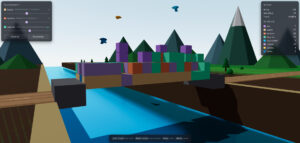
VEXTRE uses augmented reality to visualise socioeconomic data from the municipalities of Extremadura. ALVEX extends this territorial inquiry across the Spanish-Portuguese border. Presented in Évora in 2022, it brings physical sculpture and three-dimensional virtual environments into a shared space, inviting audiences to construct their own narratives of cultural identity.
The transformation of data into spatial experience gives viewers a position within the work. Information can be encountered through scale, movement and proximity. This shift invites a different relationship with the territory: one in which its representation remains open to the perceptions and interpretations of those engaging with it.
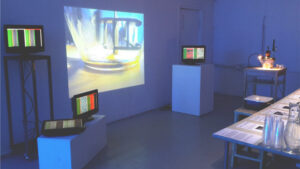
The question of how information relates to lived experience also appears in From DNA to NSA, created with Gisle Frøysland within the NSA collective. The project sets up a do-it-yourself laboratory in which visitors extract DNA using everyday materials. Public genetic records are also translated into sound and visualisations.
The encounter with genetic material gives the issue of privacy a physical dimension. Information usually associated with specialised laboratories and remote databases becomes something participants can see and handle. The work invites reflection on the passage from biological material to data, and on the interests and infrastructures that organise that passage.
Solar4Rain, another NSA project, connects Bergen and southern Extremadura through a speculative exchange of water and sunlight. Plants, sensors, solar panels and irrigation systems support an installation that imagines cooperation between places with contrasting climates. The connection is symbolic, proposing an alternative relationship between resources, territories and need.
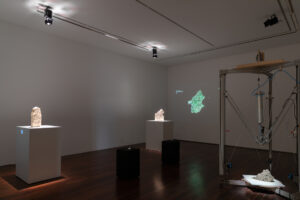 Here, the artwork asks how technological systems might support ecological interdependence. Its speculative dimension makes room for imagining infrastructures organised around mutual support. Cooperation becomes something to explore through the behaviour of an installation and the relationships it stages.
Cajaraville’s current engagement with artificial intelligence belongs within this broader investigation. In her questionnaire responses, she describes using ChatGPT and Claude Code, with AI serving both as a working tool and as a component of artistic practice. Her interests include coding, agents, responsive systems, virtual reality and the collection of online data.
She is interested in AI-generated images as tools within the creative process, but does not regard them as the intended final outcome of her own work. Her own interest lies in what AI can facilitate within the development of a work: writing code, connecting processes and supporting experimentation with complex systems.
Asked what role artists should play in shaping AI, she states:
“Artists could be shaping AI by using it in new challenging ways, experimenting, challenging bias, proposing new applications to AI.”
Her words locate the artist’s role in the ability to test and redirect technology. Using a system becomes an opportunity to question its assumptions, explore its limitations and propose applications beyond its anticipated functions. Experimentation contributes to the discussion of how AI should develop.
This possibility depends on access to knowledge and resources. Cajaraville identifies costs, limited funding and the time required to study AI as barriers. She calls for technical training, residencies and structured research programmes, alongside access to open models that artists can train with their own data.
 These needs concern the conditions of artistic research. Developing an interactive work requires time to learn, test and revise, often in dialogue with other areas of expertise. Fair remuneration and sustained support determine whether that process can take place.
Her concerns also encompass copyright, authorship, corporate concentration and environmental impact. These questions connect the use of AI to the infrastructures and resources on which it depends, extending the artist’s responsibility beyond the immediate results produced by a tool.
Asked what insight she would contribute to future discussions, Cajaraville identifies:
“AI as a facilitator for working with complex systems that combine art, technology, data, ecology, infrastructure, and citizen participation.”
This perspective brings her engagement with AI back to Territorial Intelligence. The potential of a technology is considered through the relationships it helps artists explore and the forms of participation it enables. Across Cajaraville’s practice, art creates situations in which information can become experience, experience can generate questions, and those questions can open new ways of inhabiting a shared territory.
Bio
Maite Cajaraville is a Spanish media artist whose practice spans installation, net art, audiovisual performance and artistic research. Her work investigates relationships between technology, society and territory. She co-founded LaptopsRus with Shu Lea Cheang and works with Gisle Frøysland in the NSA collective. Alongside her artistic practice, she has co-curated the Piksel festival in Norway with Frøysland since 2014.